Sunday, September 20, 2009

Episode 14: In Which DFM Kills 3 Birds With 1 Stone, and Eats Pig's Blood And Liver Loaf

Since my weekdays are invariably spent going to work meetings or climbing, that leaves only the weekends to try and catch up seeing all of my friends who keep asking me to have lunch with them.

Last week I went to Gwanghwamun with my Korean friend from Canada, Charles. This week I had promised Charles I would meet him again, but I also needed to meet Sung-bok and Woojin (not the Phys Ed teacher) for the first time since coming back, too. So I hatched a grand scheme to try and have all four of us meet in the same place for lunch. However, getting four people together at the same time, in the same place, in a city as big as Seoul is no easy task. We finally did find an agreeable time and location, but ironically I was late for the meeting, as I had forgotten where we had decided to meet and at what time.

Sillim-dong is an administrative district of Gwanak-gu, which is home to Gwanak Mountain (where I went hiking with Perry back in March). In Sillim-dong, there is a special neighbourhood called Sundae Town, which is famous for its many sundae restaurants. Now, before you get the wrong impression and think we went for ice cream, I think an explanations of sundae is in order.

Sundae (pronounced "soon-dae") is an ancient Korean dish made by stuffing pig intestines with cellophane noodles (made from sweet potato), barley, and pig's blood. At our meal there was also some liver cut to look like a small meat loaf, and I was told there were even some "sausages" made from pig's stomach too. All of these ingredients were fried together at our table (what else would you expect in Korea?) with some sauces, spices, and various vegetables. Ample ssam - lettuce leaves for wrapping the meat, as in eating ssamgyeupsal - were provided, along with some ssamjang (spicy red paste in which to dip the already spicy meat).

As usual, the waitress was worried the food would be too spicy for me, but compared to gochu pepper or maeuntang (the soup with the fish head), it did not even register. At the end of the meal I had made a pig ("hero") of myself by finishing off the whole pan.

The experience was also beneficial in that it allowed me to repay Charles, Seong-bok (I've been calling him Sung-bok, but that's not exactly correct), and Woojin for having paid for the last meals we had together either together or separately (I've owed Seong-bok and Woojin a debt since April). In Korean culture, bills are rarely split, and friends will take turns buying meals for each other under the assumption that things will work out evenly in the end. Granted, it's not a fool proof system, but when in Korea...

After the meal I had to head over to Home Plus at the World Cup Stadium again and pick up some more necessary supplies. (If you remember my visit here in the first adventure I mentioned that since Koreans don't watch enough soccer to make the multi-million dollar stadium profitable, someone gained permission to put a two-floor mega-market inside under the bleachers.)

On this day, the Stadium happened to be host to the Asian Song Festival. At first I thought the hundreds of people exiting the station were for a soccer match, but there were no ticket booths set up, and the 10:1 ratio of high school and middle school girls to men seemed to suggest otherwise. I felt it might be something worth seeing, since it definitely seemed large, but soon remembered that I hate modern music and while some Korean pop songs are catchy, it couldn't possibly be worth giving up an entire evening to watch.

I was, however, intrigued by the mobile phone game convention set up in front of the stadium. Hundreds of Koreans were standing in long lines to have a chance to play a game on a TV screen using their "hand pones" (cell phone). Playing games on a four square-inch screen with tiny control buttons seems pointless. I am also fascinated by some Korean hand phones' ability to pick up TV channels, but not when the people watching them are walking slowly in front of me, blocking the hallway to head to my next subway train.

Lee (my roommate) and his wife, however, made the mistake of actually going to the Festival. When they came home, Lee complained about how far away the seats were (on the other side of the football stadium from the stage), and his wife complained that nobody was dancing. Lee later explained that twenty to thirty years ago people used to dance, but then the police could not control the crowd and someone died, so now no one dances. Essentially then, just another in a long list of Korean over-reactions to non-threatening situations (refer to the escalator story from one of my earlier posts, and don't even get me started on Electric Fan Death).

Friday, September 18, 2009

Episode 13: In Which DFM Watches Paint Dry, And A Korean Tries To Make Him Go Bald

During my last trip I wrote about the songs that the children sang in their classrooms every morning. The last song in the video from the above link is called "Tomi the Baby Squirrel." It is my favourite song that the children then sang and now still sing, and I recently found the lyrics and learned the words.

Today at school I broke out my rendition of the song and it was a big hit. In one class Tae kwon do Boy (the boy punching in the picture halfway down the linked page), nearly lost his mind. There was then frantic discussion between the children in the class, and I heard "Korean person" mentioned a few times, so I'm not sure what to take away from that. Later, in the same class that sang the song in the video everyone was so impressed that the teacher played the song on the piano and we all sang it together. It was a proud moment.

In other news at the school, the 6-year-olds were having a Mini-Olympics as part of a school wide "sports unit" on which each of the classes are working. There are three six-year-old classes at the school and they were somehow split into two teams before I arrived. One team was Team Kim Yu-na (World Champion and record-holding 17-year-old Korean figure skating phenom, who now lives and trains in Canada), and the other was Team Pak Tae-won (gold and silver medal winner at the 2008 Olympics, and the first Korean swimmer to ever win an Olympic medal in swimming).


(Both teams awaiting the start of "throw as many balls as you can as fast as you can and hope some of them land in the bucket so you can score" event.)


(Team Kim Yu-na dominating the tug-of-war event).

The "events" were well organized by the Korean teachers, with additional bonus games and prizes, and all the children had fun adapting Korean baseball player cheers to their respective team names (it helps that every name in Korea consists of three syllables, so they are completely interchangeable). Later in the day, while some of the girls were waiting for their ballet class to start, I took out one of the drums because the girls wanted to do the cheers again.

During the events, the teachers would play Korean songs that the children enjoy. One song that is impossibly popular with the children is the hilarious Norazo song, "Superman." Woojin uses this song for the children's warm-up during Phys Ed class on Mondays, and I had always wondered what its name was until one of the teachers told me today. I have since added it to my list of Korean songs I will memorize in an attempt to impress the children, not to mention I like the song.

After school some of the children stay until 6:00 or later because their parents have opted for baby sitting. I always feel bad for the Korean teachers who have to stay until 7:30 PM every day, are forced to babysit on Saturdays too, and still make at least $600 less a month than I do. I also think it's funny that foreign teachers who get paid more, do less, and finish at 3:00 PM can't figure out why some of the Korean teachers are not more happy to see them (especially since the Korean teacher always has to stay and assist the foreign teacher as well).

After school today, some of the girls cornered me after school and made me sit down on a tiny chair about six inches off the ground. They proceeded to tie a cape around my neck and give me a "hair cut." After my ears had been lowered I had my hair combed, albeit rather aggressively it seemed for a “beauty salon.” The Korean English teacher joked that if I wasn't careful I'd lose my hair. In Korea it seems that everyone is always afraid that I will lose my hair, either from acid rain, or stress, or hair cuts. I should just shave it all off as a joke one day.

. . . . .

While normally I would go to climbing after work, today was the day of the monthly Ace climbing competition so I decided to go home first and rest. I was actually a little surprised when Ji-hyeun had told me earlier this week that the competition was today, because it seems like just two weeks ago that I had come in to surprise her with my return and she told me that I had just missed the competition and would have to wait four more weeks for this one. Time really is flying by now.

On my way home to rest though, I had perhaps the biggest case of culture shock I've experienced in my three total months in Korea. A road works crew was repainting the lines on the road leading from the subway station to my home. However, there were just four men, and the road was not closed. I watched them for a few minutes, and the efficiency with which they worked was nothing short of amazing.

At the time I was watching them they were working on repainting the yellow and white lines crossing the entire width of a five foot wide (front to back) and twenty foot long (curb to curb) speed bump. One man would put a wedge down at the front of the bump. A second man moved the painting machine into position by placing its front wheels against the wedge. A third man would then place a wedge at the back of the hump. The fourth man stood behind the first man and encouraged the other men to hurry, while looking over their shoulders to make sure there were no cars coming.

The machine they were using seemed to shoot flames from underneath it to dry the paint almost instantly as soon as it was applied. I saw some other pedestrians test a freshly painted stripe with their shoes, and not a single drop of paint was disturbed. When lines on the road are repainted in Alberta, you can see yellow or white tire tracks turning left through the intersection after they've driven through the crosswalk that took a group of unionized workers three days to repaint.

I rested at home for one hour before leaving again to head for the competition. When I returned to the same site, the workers were gone, and all three speed bumps on the road had been completely repainted in yellow and white alternating stripes across their entire length.

. . . . .

Earlier in the day, Ji-hyeun had sent me an sms message (text message) telling me not to forget about the competition because she had something to give me. A number of days (if not weeks) prior I had told Ji-hyeun that I needed to buy some Korean books for children so that I could practice my Korean. When I arrived at the gym today everyone had a silly grin on their face, and Ji-hyeun presented me with two classic David Shannon children's books translated into Korean: David Goes To Kindergarten, and No, David! I was pretty impressed with the thought she put into the gift, since a) I teach kindergarten and b) David is pretty close to DFM.

The competition this month was pretty small, with only about fifteen people attending. I ended up winning my division, but since there was only one other competitor in the division it was hard to feel overly proud. After the climbing we all went up to the “Sky Lounge” (just the roof of the building in which Ace is located) and a massive barbecue was prepared.

We were cooking on the old fashioned charcoal barbecues (forgive me Hank Hill), but unlike when my family used to use one of these, the Koreans did not try to light the charcoal bricks with matches or other such primitive lighting tools. I suspect Koreans would die if they had to wait that long for anything, so they use a propane torch to speed up the process exponentially.

Nothing special to report about the eating, just the usual great time I always have eating with Ace climbers. However, this time I attempted to eat an entire hot green gochu pepper. You may remember that I mentioned in a previous post that these were by far the spiciest things to eat in Korea. My last attempt was hiking with Perry way back in March. It didn't go so well as I started hiccuping aggressively and I thought my mouth was burning so badly I thought it was on fire.

This time I thought I had adapted a little better to the spicy cuisine here, and felt it might be time to give the demon pepper another try. I still hiccuped like mad, and my eyes were watering so badly I couldn't see, but I managed to endure three bites over the course of the night. I'd say the pepper was four bites long, so next time that gives me something to aim for.

Episode 12: In Which DFM Suspects Big Brother Is Watching Him, And Takes Is Taken Away From A Subway Station In A Stranger's Car

On my way to work today I got the rare chance to witness some good old-fashioned racism first hand. I was sitting on the subway and two seats over was a black man. An older Korean woman came and sat down between us because there were no other seats. Later, when three seats opened up across from us, she got up and walked over. Had she sat in the middle seat I would have thought, "she just wants a more comfortable seat" and would have thought nothing of it. However, she chooses to wedge herself between a pole and another Korean woman who was wider than either the black man or myself.

When I finally got to work, I was met by an unexpected guest. I never did learn his name, but he was there when I showed up and proceeded to follow me around for the majority of the morning.

During my last stay here, I heard of a teacher for the same company who had the cops come and inspect his class and arrest him for teaching English (our visas do not cover English teaching). What he was doing, and I am doing is not illegal. I am teaching art, not English, and so legally I am safe. However, this other teacher was also legally safe, and he was arrested by the police who hoped to get a bribe payout by his boss. Our boss instead hired a lawyer, at considerable expense, and beat the charges. Regardless, the situation was fairly stressful for everyone.

Not wanting to experience the same unpleasantness myself, I felt a bit uneasy by presence of this strange guest who seemed far too official, and seemed to be asking a lot of questions about me teaching the children English. Later, though, I found out that he was from the head office for the Korean English teacher at the school and must have just been trying to ascertain the progress of the children. He cannot have been too impressed though, since the children seemed as wary of this new "friend" of mine as I was, and would answer "are you a foreigner?" to him (in Korean of course) every time he asked them a simple English question. (Note: he was Korean.)

In other interesting happenings, the six-year-olds (Canadian five-year-olds) were making banana and apple smoothies. To cut up the apples and bananas, each pair of students had a plastic knife (bigger than a butter knife you'd use at a picnic though, and thicker too). One of the boys came up to me and decided to show me his knife fighting skills. When I told him he could not chop my arm with his banana slime-covered knife, he turned the knife on himself and showed me his seppuku skills (look it up). Although he was just joking, I'm sure glad Mr. Official had stepped out of the room at that moment. Yes, I understand Korea has the highest suicide rate in the world, but usually Korean men wait until they're a bit older and have kids and a family of their own and are passed over for a promotion before they kill themselves. Furthermore, it is considered impolite in Korea for a younger person to try and rise above his age-defined place in this rigid social hierarchy by committing suicide before his elders do. (Sorry to all the Korean readers out there for my tasteless joke.)

After work I went to teach a private lesson in some outlying area of Seoul. I had no idea who I was meeting, but my friend (whose job it is to find teachers) needed a favour this week and asked me to go because he needed a teacher on short notice (that's how I got my current job too).

The lesson took place between 5:45 and 6:45 PM. I thought I would be teaching one or two children, but when I was taken to the apartment there were six children in a living room. I suspect that the woman had told all her friends about the coming tutor, and they decided to get in on the good fortune by sending their kids over.

I already figured an hour would be a long time for the kids, who could not have been more than nine. Today though, I found out first hand that children that age have a maximum attention span for learning English of one-half hour. The children started out eager to learn, but the last fifteen minutes of the lesson were hell, as I had children jumping on the couch and pretty much doing everything but studying. Normally I would not have cared, since they had covered all the necessary material (actually, they were far beyond the material being covered and were probably quite bored). However, I was being paid for an hour, so I got my whip out and cracked down hard. Eventually (I'm not sure how) I managed to get everyone back on task and we hobbled towards the finish. It was fairly stressful, and I was worried I had failed, but when the mother came back in to the room she seemed to think that I was the world's greatest tutor.

She begged me to come back and teach the children, and even offered me $60/hr. I suspect the reason she has so much trouble finding tutors is that no one wants to teach those kids for a full hour.

I felt bad for her actually. She was clearly trying very hard to learn English herself, and even though it would appear to most Canadians that she was pushing her children too hard, Korea is a country where, for better or worse, the government has told its citizens they need to learn English. In many cases, companies will hire or promote an employee based solely on his or her level of proficiency in English, regardless of that candidate's job-related skills, or whether or not the position in question actually requires English language proficiency. This woman was only trying to provide her children (and those of her friends) with a chance to find a successful job. Sadly, though, I really did not want to add another full day of travelling to my already exhausting schedule - not to mention lose another day of climbing - so I told her I was too busy with an ever changing work schedule (not entirely untrue).

Tuesday, September 15, 2009

Episode 11: In Which A Building And A Freeway Disappear, And The Average Temperature of Downtown Seoul Drops 3.6 Degrees

Woah, what a busy first two full weeks! I even originally typed in three weeks, because it sure has felt that long. Seeing as how this would be my first weekend being able to stay home, I decided to try and get some rest and catch up on life - I have been a week behind in just about everything it seems.

Since returning to Korea I have only seen one friend, Hyeun A on the first Saturday, but even she is upset that I haven't talked to her since then. Well, it'll be at least a week more for her because this weekend I decided to see Charles.

Charles is a Korean whom I met in Canada when he was studying English at the college in which my rock climbing gym is located. He had been asking to see me since I came here and I decided that this weekend was probably the best time to take him up on his offer of lunch.

I had originally hoped to have a relatively quick lunch and then perhaps see someone else for supper, but even though everyone in Seoul seems to always be in a hurry it also seems genuinely impossible to get anywhere fast. Actually, let me rephrase that: It is genuinely impossible to get anywhere fast from where I live.

I used to think that I was a bit inconvenienced living in Itaewon because it had no transfer stations to any of the other major lines. I always had to go two or three stops this way or that way first before I could transfer. Now though, I would give my right pinky toe to live there again and not have the ridiculous 1 hour commuting distance from where I live to anywhere fun. That said, I still enjoy my new neighbourhood, especially the crazy non-existent traffic rules that see people walking down the middle of the road, an uncontrolled major four-way intersection, and cars parking two wide on the narrow streets. But I digress...

When I met Charles it was a beautiful, sunny day out. Before we could eat lunch we had to first find some British office of something or other, because Charles wanted to apply to take a British English fluency test. Within about five minutes of our arrival, a massive thunderstorm broke out and monsoon-like rains battered the windows and the street below. I couldn't understand how such a large storm could come literally out of nowhere, but within another fifteen minutes it was gone again and the weather was sunny and warm. All I can say about that is, "really strange." (Sorry, I've been living around too many people for whom English is a second language, and "strange" is used to describe everything.)

After Charles finished his application we went to find a restaurant "famous for delicious, traditional Korean food." However, even Koreans like Charles can underestimate how quickly things change in Korea. It had only been a year since his departure, but never-the-less the building in which the restaurant was located had been torn down, and the restaurant gone. Undaunted, and with Charles determined to give me some good Korean food, we went to a nearby restaurant for some nakji bokum.

Despite being told by many Koreans it was "not octupus but like octopus," nakji is in fact octupus. Nakji bokum involves mixing fried octupus legs together with vegetables and spicy red pepper sauce (although that's not saying much, since Koreans love spicy food so much I've even seen them put pepper sauce on pineapple).

The restaurant at which we were eating this nakji bokum had earlier been featured in a prominent Korean television drama. According to Charles, a woman in the show was suffering from stomach cancer. Whether she wanted to thumb her nose at the disease by eating spicy food again before she died, or she had beaten the disease and was trying to celebrate I don't know, but either way she came to this restaurant to eat some spicy food. In fact the table at which we were eating had a framed picture from the show, featuring the two actors eating some supposedly spicy food not far from where Charles and I were then sitting.

Whenever I go out eating though, Koreans never seem to believe me when I tell them I can eat anything. The waitress at this restaurant even made a point of asking Charles if I could "handle" it. They needn't have worried, as I nearly finished off the whole giant bowl save for three pieces of octopus leg (my stomach was so painfully full I just couldn't stuff them down). The meal was nowhere near the spiciest or hottest thing I've eaten in Korea. Hot green gochu pepper dipped inssamjang sauce take first place in that category, followed closely by maeuntang (long time readers may recognize that name as the spicy fish soup with gochujang - gochu pepper paste - and kochukaru chili pepper I ate in Gyeongju that had the fish head in it).

After the nakji bokum I took Charles to the nearby Coldstone Creamery I had noticed on the way over. Charles told me that he usually ate ice cream at Bakin Robbins, but I assured him that this place was better (Coldstone Creamery is the ice cream place I took Hyeun A too back in April, my last week living in Itaewon). After buying him the Coldstone Creamery signature Cheesecake Fantasy ice cream bowl, he was forced to agree as well.

Charles wondered how I could eat the ice cream after I complained about my stomach hurting just fifteen minutes later. I explained to him that much like a dog always leaves a little bit of urine left to mark his next tree, I always leave a little bit of my stomach for desert. On second thought, perhaps a cow's stomach would have been a more tasteful analogy...

After lunch we went for a walk down Cheonggycheon. Charles told me that the roughly 6 km man made stream was the work of a former Seoul mayor, the late Lee Myung-bak, and helped him to later become the President of Korea. [Note: Lee Myung-bak is not dead, he is still the President of Korea. I had confused him with Roh Moo-hyun. My appologies.] The site was home to a real river some fifty years ago, until Korea built a freeway over it, and then a second elevated freeway over that.

The $281 Million US removal of the freeways was not completed without opposition, but (according to Wikipedia) it resulted in the decrease of automobile traffic to the downtown area by 2.3%, and an increase in bus and subway ridership to the downtown area by 1.4% and 4.3% (or 430 000 people) respectively. Furthermore the water and trees decrease the average the temperature of the surrounding area by 3.6 degrees centigrade compared to other parts of Seoul. I was also happy to hear from Charles that most Seoulites now consider the project to be a success, as I can say from my own experience that it is a rare pleasant environment in an otherwise grey coffin of soullessness. While the walk was lovely, I eventually had to get head back home. My walk, though, was not the only good thing to come to an end this day.

There is a fruit stand on my way home that I frequent once or twice a week to do all of my fruit shopping. The owner is a nice man in his late forties who is always happy to let me practice my Korean on him, and usually gives me some sort of deal for being a nice young foreigner. Tonight when I stopped in to get my weekly fruit haul I noticed that my beloved nectarines were missing. Apparently each season has its own fruit, and the season for nectarines has come to an end. There is some consolation though, as Lee told me Winter's fruit is the famous and delicious Jeju-do tangerine (mandarine orange). I was fortunate enough to catch the tail end of this season during my last visit here.


(Charles, standing in front of the statue of Admiral Yi Sun-shin in downtown Seoul. For thse of you who have a 50 Won coin handy, you can see Yi Sun-shin on there too. [Note: No you can't. Yi Sun-shin is on the 100 Won coin, not the 50.] This famous admiral is noted for defeating the Japanese navy during the Japanese invasions of Korea from 1592-1598. He is also remembered for designing the Geobukseon, or "turtle boat," that ruled the Sea between Japan and Korea during the Joseon Dynasty. Behind the statue is the President's home, The Blue House, and Seoul's tallest mountain range, Bukhansan, on which I spent considerable time hiking and getting lost as well as running a half-marathon back in April. One block in front of where Charles is standing is Cheongyecheon. Charles explained that this placement was part of the East Asian Feng Shui sytem of creating harmony in one's environment.)

Sunday, September 13, 2009

Episode 10: In Which DFM Channels Sigourney Weaver, And Builds A National Treasure Using Child Labour

Friday was an exhausting day. Actually, the day wasn't exhausting, but I sure was exhausted during it.

On my trip to school I was so tired I missed my transfer station twice. It wasn't that I was sleeping either - I had looked at the platform sign and said to myself "okay, one more stop," but somehow it just failed to register that one more stop meant that I should get off at the next platform. Fifteen minutes later I did the same thing again, this time when I should have gotten off at my final destination. It was highly fortunate I had left fifteen minutes early that morning, because my two errors added twenty minutes of travel time to my morning commute.

When I showed up to school I was prepared for two scenarios: one in which I had to teach six thirty minute classes of my own material with no curriculum or help (like I had the week before), and one in which I would be told that I should teach the originally planned unit for that day which now made no sense at all since on Wednesday I found out the children were not doing that unit (it's too long of a story to fit nicely in this post, but not long enough for its own post, so I've left it out). When I showed up ten minutes before class (the train fiasco), I was told to use plan B (apparently the school had talked to my boss who then told them they had to teach this unit today).

Well, wouldn't you know, not everyone got the message. Although I was able to finish the lesson easily enough with the five-year-olds, since I had all the materials with me, the two six-year-old classes had none of the materials they were supposed to prepare for me, and so I had to make up a thirty minute "art lesson" on the spot... with no art supplies.

The seven-year-olds had the supplies somewhere, but the first teacher must not have known they would be needed either since they were not ready when I came. I tried to explain to the teacher what I needed, but she couldn't understand. We then tried to use a girl who had moved from Australia and could speak English to translate, but I'm not so certain she's confident with her Korean, because when I asked her to tell the teacher what I needed she looked sick and said "I don't want to."

Eventually, I was able to get across what I needed, and while the teacher went on a search for the materials, I tried to entertain a rowdy class with some songs and games. The songs were well received, though perhaps a little too well received - a few boys decided that it was necessary to start kicking other students. One boy hauled off and Tae Kwon Do kicked another girl for, as far as I could tell, was "no reason." Other boys were pushing each other and soon students started falling over and into other students. I stopped the music and even though the students have limited English, the Ripley Death Stare from Alien is apparently International Language for "you'd better stop if you know what's good for you."

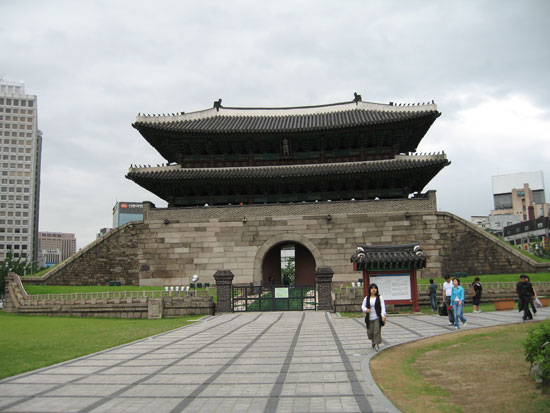
When I did get the class settled, and the materials finally arrived, I set the children loose on trying to make Namdaemun gate with straws and glue. Not having access to a giant piece of paper, or straws, or glue myself, I could not do the assignment at home before I came to school. Consequently, my instructions were not overly clear, but somehow the students managed to pull together and make the famous gate (National Treasure #1). For the next class though, I started with some more clear instructions and the results were downright astonishing (especially since I've since done this assignment at another school with less spectacular results).

While my first class got themselves into fights over who had which colour of straws, or how many, my second class quickly divided into tables and seemed to be racing to try and finish first. I'm almost certain it was the result of good discipline from the teacher (or the absence of a few rowdy boys from the other class), but this class has always been a pleasure to teach. It could have also been that I told them I would take a picture of them if they finished.

Below are the final results. Keep in mind these are what we in Canada would call six-year-olds, and they made these creations with no help from myself or their Korean teacher.


(Starting with the roofs.)


(Getting an outline.)


(Almost finished.)


(Keep in mind the picture of the gate is upside down in this view, so it looks worse than it was.)


(Best pose ever. Thank you boy in orange.)


(Second place gate, but by far my favourite picture. This group had seven kids as you can see, but they worked together almost flawlessly and were the first group to finish.)


(Hands down the first place winner. This group's straw gate was almost better than the original version I drew on the white board at the beginning of class. I'm pretty sure that boy at the back walked through this picture on purpose though.)

To compare the pictures with the original, click here.

Friday, September 11, 2009

Episode 9: Climbing Trip, Part 3

This episode really has nothing to do with the climbing. Instead it is something of a "director's cut" DVD, in which I write about all the bits of information I couldn't find room or time for in the other episodes.

First, I think the thing that impressed me most about climbing in Korea was the trust Koreans have in other climbers not to steal their stuff. On quite a few routes we found a full set of quick draws (the metal clips that your rope goes through) already left on the bolts in the rock. At an average of about $15 per draw, this meant that each route had over $100 of quick draws left on it, supposedly to be retrieved later.

Actually, our own group left a number of quick draws up over Saturday night, and sure enough they were still there when we returned the next day. We even left our rope bags hidden under a rock to save weight, and those are about $200 for a decent sized bundle. Back at the camp we had left all our valuables in the tent all day, unattended, and they were still there when we came back. Upon our arrival after Sunday's climbing, we found a family had patiently waited all day for our return so that they could ask us for a peek inside.

The second most impressive thing about the trip were the size of the bees. Redish, with black stripes, the Koreans call them "horse bees," and I would say they are roughly twice the size or more of a normal bumble bee. The Koreans told me that although they have the temperment of a normal bumble bee they can sting multiple times without dieing, and that the venom from one horse bee can knock a grown man out, but if three bees sting you it can bring death.

Since I am talking about large insects anyways, I should take this opportunity to mention that last week I saw a mantis for the first time in person. It was in a tree just over my head, brown in colour, and about five to six inches long. While it did not frighten me at the time, I suppose there was a miniscule (and by "a miniscule" I mean zero) chance it could have accidentally dropped out of the tree on my head and proceeded to hack and slash me to... well, pain I suppose. Now that I think about it, I should have killed every mantis in the world for this one having the gull to scare me.

On the trip back home I saw three separate police cars on the highway with their lights flashing. I've mentioned before that I don't think too highly of the Korean police officer's work ethic, so I was amazed to see flashing lights on a highway actually belonging to a moving vehicle. In fact, until this time all of the flashing red and blue lights I had seen were just police lights attached to a pole or a parked vehicle (not a police car), in an attempt to trick drivers into slowing down.

Nearer to Seoul, I also saw a woman with her driver's side window rolled all the way down, and her Chihuahua literally hanging halfway out the window, whilst standing on her lap. That one just made me shake my head.

However, none of these things tops the fact that while listening to some Korean radio on the way home, the DJ actually played "Youth Gone Wild," by Skid Row. I've often felt that in many ways some of the cultural trends in Korea mimic those of Canada in the late '70s, and early '80s. However, I never thought I'd hear late '80s hair metal on the radio, and especially not that song (note: I really like the song, I'm just not certain it belongs on "modern radio.")

To finish off I'll include a few pictures of the climbing, etc. for those of you who had expressed interest.


(This is a "Tourist Guiding Map" of the area in which we were hiking. You can see the red dot which marks where location of the map. However, unless you are a tourist who can understand Korean, you might have no idea where to go from there.)


(I didn't get any pictures of the "horse bees," because they don't like to cooperate by staying still - unless it's to hover around your legs while you try to shoo them away - but check out the size of the beetles compared to Choi's fingers to give you an idea of the size of insects one finds in Korea.)


(One of the many beautiful tiger lillies in this section of Seonunsan Provincial Park. My camera decided to focus on the background for this shot, but I feel it makes for a more interesting picture so I decided to keep it anyways. I cannot remember the exact name of this flower in Korean, but Ji-Hyeun told me it means something similar to "longing for a loved one you can never see." When the flower is in bloom the leaves are not visible, but when the bloom is over, the leaves come out while the petals disappear. The Koreans compare this situation to what Romeo and Juliet experienced, and thus the rationale.)


(Choi's DSLR takes a much better picture of this scene- as he can change the depth of focus - but these are a bunch of large rocks Choi managed to balance on their ends. I tried it, and the points are much smaller than they look in the picture; i.e., it was quite hard.)


(I can't remember her name, but the woman in front is the same woman who finished her 5.12a project this weekend. Here she watches Rina Park climbing Baek-am 3, 5.10b, while Ji-hyeun belays.)


(Mystery 5.12a woman's boyfriend and my climbing/belay partner, Han-soung, climbs Baek-am 3, 5.10b.)


(This is Korean language student, originally from Los Angeles now studying in Jeju-do, attempting to climb the "harder than it's graded" route, JCC 3, 5.11b. Ji-hyeun and Rina both said I could climb this route because I have good footwork, but considering this woman flashed Baek-am 5, 5.11a (finished the route on her first time), and it took me 6 tries, I'm not so certain I believe them. Then again, they also said I could send a 5.11a before this trip and I didn't believe them then, either.)


(Choi making easy work of Baek-am 5, 5.11a.)


(Ji-hyeun, looking a lot like Choi, also making Baek-am 5 look easy.)

Wednesday, September 9, 2009

Episode 8: Climbing Trip, Part 2

Saturday morning we embarked on the one-hour hike to reach the climbing crag. It was hot and muggy out, and the terrain was steep. Along the way we passed pumpkin plants, tiger lillies, a green tea field where a famous romantic Korean TV scene was filmed, and a 1000-year-old temple. There were also fantastically beautiful streams, and this view (below), which in person was worth the trip just to see (even if I had not gone climbing).


When we got to the mountain I was in awe of all the giant jugs (large, easy to grip holds) I saw. I used to wonder why companies would make artificial humongous holds that were easy to hold onto, when every route I had seen climbing outdoors (to be fair, not that many) seemed to contain holds you could barely see. On this mountain though, there seemed to be holes so big I could crawl inside of them! (Later I did climb into one of them and Ji-hyeun said the rock "ate me.")

The group set up on a large rock and we walked down the crag a short ways to set up at the "easy route." I figured that this was the easiest route on the wall and we would be doing it as a warm-up for the 5.10b everyone figured I could climb this trip. I also figured it would be graded a 5.9 (within my capabilities for a warm up).

The route was called "Baek-am 3" (pronounced Beckam, as in David Beckham), which translates literally to White Rock (route) 3. My previous attempts at outdoor rock climbing had been less than brilliant (climbing a good two full number grades - 8 letter grades - below my highest gym grade). This was my sixth try at sport climbing outdoors though, so I was finally starting to become more comfortable and figured I could at least climb a 5.10b (my previous best outdoor climb being a 5.10a).

I flashed my "warm up" route and when I came down everyone said, "wow, you're footwork is very good" (it ought to be after more than five years instructing in a climbing gym). "You can flash 5.10b!" I said, "thank you... where is the 5.10b?" I was quite surprised when everyone pointed at the route I had just climbed. It hadn't actually seemed that difficult, which I attribute to the fact that I thought it was only a 5.9 and was therefore more confident.

With my new revelation that confidence makes climbing easier, I moved to the next hardest route at the crag, the 5.11a classic, Baek-am 5. The first day I worked the route three times on top rope, and once on lead (harder, with longer falls). Each time I tried though, I fell on the last move. I knew I could easily do the last two moves, because I had completed them every time after resting, but I just could not muster the endurance to complete the route in one clean run and I was starting to lose confidence.

On Sunday I was still tired from my all out effort on Saturday. I only attempted the route twice, and both of those were on lead. On my first attempt I finally made the last move, but could not muster the energy to make the final match - which is by far the crux of the route. The desperation attempt to make the final hold produced a big fall, but I was expecting this. I was not, however, expecting my foot to slip under the rope as this happened. On the subsequent fall, the rope stretched violently across the back of my calf and I received a gigantic rope burn that scorched the top few layers of skin right off my leg. Choi cleaned the wound out with rubbing alcohol, which stung quite badly and caused my to cringe and twitch every time the torture juice touched me. My belay partner thought this was quite funny, and he laughed every time I jumped or twitched.


(When I showed the kids at school my giant scab, one of the little girls thought that my leg was hot because she heard it had been burned. She bent over near my leg and blew on it to cool it down. Bless her heart.)

After a lunch and a rest I decided to muster what little energy remained for what I decided would be my sixth and final attempt for the trip. While I felt a little tired, I had a secret weapon. On my last attempt, I had discovered a trick resting maneuver in which I wedged my forearm between my knee and the top of a small "cave" in the wall. I call it an advanced knee bar, since my lower leg was too short to do a regular knee bar.

The rest allowed me enough time to recuperate, and I was finally able to complete the final move. I felt like Chris Sharma in many ways as I hung on the rope for a minute at the top of my route: I had completed a back-to-the-wall, stand on a ledge rest like he did on Clark Mountain in the DVD King Lines (if you've seen it, you know what I'm talking about), I had overcome my anxieties and was able to relax and enjoy the route, and I had dedicated myself fully to the route. I suppose the only differences would be that Chris Sharma gets paid to climb the hardest routes in the world, and it takes him upwards of four years to finish some of them, whereas I had struggled to climb something he would have finished-off as a thirteen-year-old.

On the Saturday, one of the women had completed a 5.12 "project"she had been working on for the last 2 or 3 years, and to celebrate we ate a 3 course dinner (made on the portable stove, with camping utensils and dishes) consisting of a vegetable and beef curry, a samgyeupsal-like dish, but with eel as the meat instead of pork, and some corn with cheese melted over it. Of course there were multiple side dishes too just like at a Korean restaurant. Every time I saw one of the Koreans making a new dish, I would say "amazing!" which garnered many laughs. I tried to explain the glory of hot dogs and marshmallows to them, but they didn't seem to make the connection with how that was better than the 3 course feast. I guess they don't have The Alberta Advantage over here though, so it's not really their fault.